My airport driver needs my flight number. Who needs the rest of the email?
An airport pickup shows how much personal data an AI booking service really needs, and what to ask before sharing a family itinerary.


A JOURNAL OF PERSPECTIVE
Progress gives us possibilities.
Perspective helps us choose.
Notes on health, money and the future—exploring what is changing, what we may have overlooked, and what it could mean for our lives.
TURN THE PERSPECTIVE
If we can detect more, what should we do differently?Fresh questions. Considered perspectives.
An airport pickup shows how much personal data an AI booking service really needs, and what to ask before sharing a family itinerary.
The firm is licensed. How do you check whether the person who sent the offer represents it?
What melanoma patients and investors can each learn from the same trial.
A pharmacy reading, a kaya toast excuse and one question to ask before you leave.
Three siblings split Mum’s clinic bill. What about the half-day’s pay her daughter gave up to take her?
A parent can keep the value of an investment private and still tell the family which broker to call.
Two parents can have the same EPF balance and very different room to give. What i-Legasi changes for EPF, for families and for your own retirement.
The reasoning behind Solve Everything, two real research examples, and what I take from a hopeful—but uncertain—medical future.
A fake interview was one entry point. My takeaway: security should allow for human mistakes and limit how far one breach can spread.
Humanoid robots invite us to imagine a future with more independence, better support—and perhaps someone else doing the washing-up.
Manufactured organs could expand our options. What separates a scientific breakthrough from a treatment a particular family can actually access?
Google Cloud revenue doubled, yet Alphabet shares fell. A closer look at growth, expectations and the cash needed to build AI’s future.
ER-100 brings new hope for restoring function. How should we think about longer lives when healthy years and care needs remain uncertain?
MediAsas invites a better comparison: what costs would a plan carry, what would our household retain, and could we sustain both through a difficult year?
A legacy needs a workable handover as well as valuable assets. Who could access cash, with what authority, and when?
AlphaGenome Atlas offers more promising research clues. My view on separating faster discovery from better outcomes—and asking who will be ready to benefit.
Earlier cancer detection offers a hopeful possibility: more time to understand, prepare and explore our options. What would help us make that time count?
A NOTE FROM THE EDITOR
“I’m interested in a brighter future.
And the questions that help us prepare for it.”
Hope and preparation belong in the same conversation. This journal makes room for both.
A little more about Risk Steward ↗Health & Longevity
Imagine being told you need a new kidney—and that one could eventually be made available without waiting for a human donor.
That is the future Martine Rothblatt’s United Therapeutics is working towards. It is an ambitious idea, and one I find deeply hopeful.
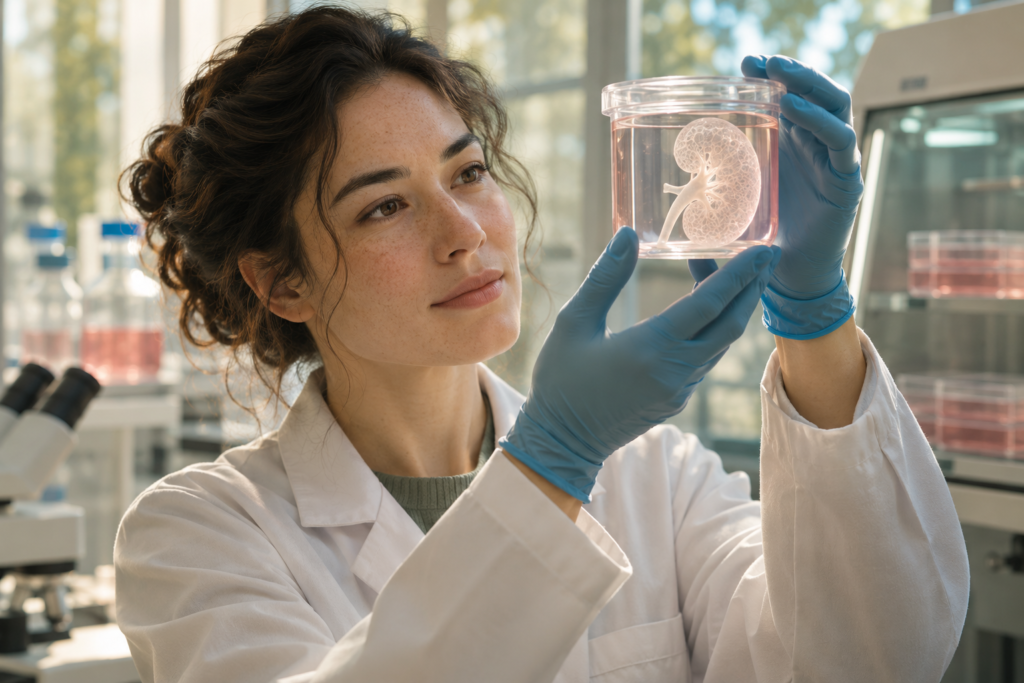
“Cloning our organs” is an intriguing description, but the work takes several forms. One involves genetically modified pigs whose organs are designed to be more compatible with people. Cloning helps reproduce those donor animals; it does not mean copying a patient’s own kidney. [1]
United Therapeutics’ EXPAND trial is already testing kidneys from pigs with 10 gene edits in people with end-stage kidney disease. Researchers are tracking survival, kidney function, quality of life, rejection and infection. The organs remain investigational. [2]
Other teams within the company are exploring organ scaffolds populated with human cells, including 3D-printed lung structures. A June 2026 peer-reviewed study reported expanding human lung cells into the hundreds of billions—an important step towards having enough suitable cells to engineer lung tissue. It was not a demonstration of a replacement lung working inside a person. [3]
On 20 October, the company announced its third specialised, biosecure organ-production facility. Facilities do not prove that a treatment works, but they show the scale of the ambition: making organ supply something we could build, rather than only wait for. [4]
There is still much to establish, particularly how reliably these organs function over years, how rejection is managed, and whether treatment can become widely affordable.
What draws me to this research is the possibility of more ordinary days: time with family, returning to work, making plans beyond the next hospital appointment. But it also challenges an assumption: that once a treatment exists, it becomes an option for everyone.
I would separate three questions: does it work reliably, who is medically eligible, and what would access involve? Scientific progress can change the first answer before practical access changes for a particular family. That is a reason to follow the evidence and revisit our assumptions as it develops.
I cannot put a date on that future. Still, a world with more treatment options is worth looking forward to. Preparation today can include understanding our existing protection, the cash available during illness and who could help us navigate treatment choices. None of this requires assuming that an experimental treatment will become routine.
If treatment options expand, how much freedom would our present arrangements give us to consider them?
Research reviewed: 5 November 2026. General education and personal commentary. These organ technologies are at different stages of development. CI eligibility depends on the policy’s precise definitions and conditions; a new transplant technique does not automatically qualify.
[1] Eisenson et al., Nature Communications (2024): Gene-edited donor pigs and kidney xenotransplantation
[2] NYU Langone: EXPAND human clinical trial
[4] United Therapeutics: Third xenograft production facility, 20 October 2026 (company announcement)
A QUESTION TO CARRY FORWARD
Original article ↗